Menu

Stay Connected with Saily eSIM

Three orange color link with no background
eSIM-pic01

Stay Connected in the USA with Saily eSIM

No more hassle upon arrival: with Saily eSIM, you get instant Internet access as soon as you land.

Forget SIM card queues and expensive roaming fees!
✅ Instant activation & 100% digital
✅ Fast, reliable coverage across the U.S.
✅ Flexible plans to match your trip
✅ Perfect for Google Maps, WhatsApp, social media, and more

Travel light, stay connected.
The perfect eSIM for your American adventure.

Sustainable Travel Tips

Three orange color link with no background

Our Sustainable Travel Tips

are designed to help you make your visit across the United States more meaningful, enjoyable, and environmentally responsible.  By following these guidelines, you can help protect the environment, support local communities, and leave a positive impact on the places and people you encounter.


The Basics

  • Bring a reusable water bottle. Refill it at your hotel, public fountains, or refill stations instead of buying single-use plastic bottles.
  • Share your dietary preferences before tours or activities to help reduce food waste.
  • Avoid giving money or gifts directly to individuals on the street. Instead, support local shelters, food banks, or community programs that help those in need.
  • Opt for ground transportation when possible. The U.S. has excellent scenic rail routes and bus systems or subway in some cities —avoid unnecessary domestic flights for shorter distances if possible.


Environmental Responsibility

  • Leave no trace. Always dispose of trash properly—even biodegradable waste like fruit peels or paper.
  • Pick up litter when you can; small actions inspire others.
  • Recycle responsibly. Separate recyclables from trash where facilities are available.
  • Use water and electricity mindfully. Turn off lights, take shorter showers, and reuse towels and linens in hotels.
  • Avoid purchasing products made from endangered or non-sustainable materials.
  • Respect natural areas and wildlife. Stay on designated trails, keep a safe distance from animals, and never feed them.
  • Minimize noise in parks and natural areas to preserve tranquility for both wildlife and visitors.
  • Follow park regulations. Rangers’ guidelines exist to protect fragile ecosystems. Do not disturb animals, plants or their natural habitat
  • Do not remove natural souvenirs. Collect memories, not rocks, shells, or plants.
  • At the campsites follow the instructions of our guide for waste disposal, shower and toilet facilities, use of campfire, etc.


Carbon Footprint

  • Air travel significantly contributes to carbon emissions. Consider offsetting your flight through verified carbon offset programs. It’s affordable and impactful should you add additional flights to your trip.
  • Whenever possible, use public transit, carpool, or rent hybrid/electric vehicles.


Supporting Local Economies

  • Shop locally. Purchase goods made by regional artisans and producers.
  • Dine in local restaurants to experience authentic cuisine and support family-owned businesses.
  • Book local guides and experiences. Your investment helps small businesses thrive. Hire local guides if we did not already include them in your program.
  • Pay fair prices when shopping or tipping, supporting fair trade helps sustain communities.


Cultural & Social Awareness

  • Be a respectful guest. Ask for permission before entering private property or taking close-up photos of people.
  • Respect diverse cultures and lifestyles. The U.S. is multicultural; embrace local customs and traditions.
  • Keep an open mind. Avoid judging unfamiliar habits, diversity is a core American value.
  • Mind personal space and public behavior. Be courteous in shared spaces such as parks, restaurants, and public transit.
  • Use inclusive language and show kindness to everyone regardless of background.
  • Use your common sense. Treat people the way you would like to be treated and appreciate the diversity of different cultures.


Photography & Media

  • Ask before taking photos of individuals or private property.
  • Respect “No Photography” signs in museums, cultural centers, and sacred sites.
  • Share responsibly on social media, avoid geotagging sensitive natural areas to protect them from over-tourism.


Dress & Etiquette

  • Dress appropriately for the setting, modest attire is expected in religious or memorial sites.
  • Casual wear is fine in most places, but check local norms when visiting smaller towns or cultural institutions.
  • Always remove hats during national anthems or inside memorials as a sign of respect.


Dining & Customs

  • Wash or sanitize your hands before eating.
  • Tipping is customary in the U.S. (15–20% in restaurants). Please do not forget.
  • When invited into a home, it’s polite to bring a small gift or contribute to the meal.


Responsible Giving

  • Support verified charities or local programs instead of giving cash directly to individuals.
  • Ask your travel provider for suggestions on reputable community or conservation projects to donate to or check our website for the program we support.


Respect for Sacred and Memorial Sites

  • Be quiet and respectful in churches, synagogues, mosques, and memorials.

Travel Insurance

Three orange color link with no background

NOT AVAILABLE IN THIS LANGUAGE


What to Pack for a Road Trip

Three orange color link with no background

What to Pack for a Road Trip

You’ll want to make sure you’re prepared for any trip you take, whether it’s only a few days or a week.


  1. Water bottle – You can easily get dehydrated from traveling and eating salty snacks, so fill up your water bottle whenever you get a chance.
  2. Cooler – Save money by bringing your own snacks and keeping them cold in your cooler. This is also helpful if you buy food on the road and don’t finish it but need to keep it cold.
  3. Coffee mug – Mug is a must to use for a cup of coffee every morning, but all those paper cups the coffee shops give you can really add up. 
  4. Polarized sunglasses – We can get really bright on the road depending on what the sun is reflecting off of, so keep yourself safe and have a good pair of sunglasses.
  5. Sunscreen – You’ll need sunscreen when you’re out and about exploring, but it’s also important to have it on when you’re in the car as well. You can have one side of your face and arm exposed for hours, depending on the time of day.
  6. Bug Spray – This will help protect your skin even more, especially from pesky mosquitos and sand gnats. Try to be aware of the climate in which you are driving through and stopping, as this may affect what kind of bug spray you should use! 
  7. Portable Smartphone Charger – are a must for traveling anywhere. These are perfect to ensure your battery never dies between taking photos and updating social media to share with your friends back home.
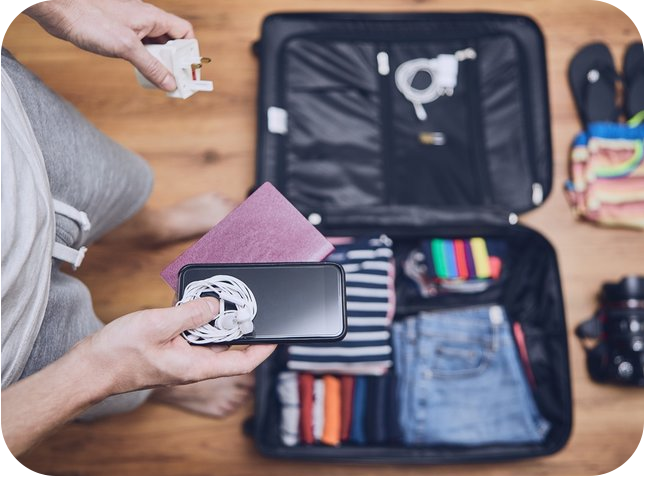
  8. Universal Plug Adaptor – The U.S. has very different outlets from Europe and even places within Europe have distinctive plugs. Think about all of the devices you’ll have to charge – your international cell phone, your camera, your tablet, and more. A universal adaptor plug will become an essential part of your ultimate packing list especially if you’re planning to travel to different countries throughout your trip.
  9. Camera – One of the other important things to bring on a road trip is a camera. Being able to take pictures whenever you want is part of the reason to drive. 
  10. Hand Sanitizer – You never know when that gas station you desperately need to stop to go to the bathroom is out of soap. Keep this in your glove box so it’s easily accessible.
  11. Secure Phone Case – You’re more than likely going to be using your phone a lot during your road trips, so we highly recommend investing in a secure phone case that can protect it during your journey! Adding a waterproof phone case is a must for road trip essentials. Better yet, most of these phone cases double as shock-proof or sand-proof, ensuring your phone will not be damaged by grains or a great fall. We want you to be safe with what could be your GPS, camera, and contact with family and friends back home! 
  12. Rain Jacket – You should always have a lightweight rain jacket on hand in case of a sudden rainstorm. Even the places that hardly get rain can suddenly dump, and you don’t want to be stuck in your car. A rain jacket lets you continue to explore the area.
  13. First Aid Kit – Although we don’t want to think about needing a first aid kit during our adventures, it is often better to be prepared rather than stuck in a situation we can’t fix. By adding a first aid kit to your road trip essentials, you can help protect yourself and your loved ones no matter what happens! 
  14. Snack – Road trips can become expensive, especially if you’re stopping every hour or so for snacks at local stores or gas stations. We recommend prepping for your trip by adding pre-purchased snacks to your road trip essentials. This way, you won’t have to continuously stop and add time (and gas and mileage!) to your trip. Ease those growling tummies with road trip snacks, that way they are in the car and easily and readily available to you! 
  15. Travel Games – These games on the go are often compact in design and family-friendly, making them easy to add to your road trip packing list, as they don’t take up much space and can truly add some fun as you cross state lines or wait on interstate traffic! 
  16. Travel Pillows and Blankets – Putting a blanket and pillow as part of your road trip essentials will have you ensure you are comfortable no matter where you are or how long you are traveling. These are also great for when you stop– you will always have an extra blanket and pillow backed and ready for you!  
  17. Paper Maps – Although many of us rely on our phones or Google Maps or a GPS to guide us along our road trip, paper maps are something you may want to consider adding to your road trip essentials. There isn’t always going to be reliable sell service, and with detours and unexpected stops needed, having a paper map can really help! 
  18. Slip-on Shoes for Comfort – Tying and retying shoes every time you stop during a road trip is frustrating and time-consuming. You also don’t want to mark up your car’s seats with sneakers, so investing in a pair of slip-on shoes is great for road trip essentials. This way, no matter where or when you can simply slip-on shoes and be ready to go. They are quick and easy, and often comfortable. 
  19. Compression Socks – During long stretches in the car, you can’t get up and walk around. Investing in a pair of socks that can help reduce swelling and encourage your circulation is great for protecting your legs during the trip.
  20. Toilet Paper or Wipes – The best thing about adding toilet paper or wipes to your road trip packing list is that they can be used for more than one thing– whether you have sticky fingers from snacks, need to do a quick “on the go” shower or wipe down, or you really need to use them for the bathroom, they’ve got you covered! 
  21. License, Registration, and Proof of Insurance – Although packing your license, registration, and insurance policy may seem intuitive, do not forget them– they are road trip essentials! You don’t want to end up pulled over, stopped, or caught up on the side of the road without your appropriate contact information. Having multiple copies and having them in your car or even on your person as you travel can help stop some heartache. You may even want to ensure your car’s manual is in your dashboard in case a light pop on and won’t shut off! 

Driving Tips and Rules

Three orange color link with no background

Driving Tips and Rules

  1. Plan your stops in advance Planning ahead increases productivity and results. You experience little or no stress and become more efficient. When you are able to carry out your plan, you are productive.
  2. Prepare your car If you can’t avoid breakdowns during your trip, you can try to prevent them by making sure your car is ready. This means topping up the wiper fluid, checking the oil level, inflating the tires and anything else you may have been putting off.
  3. Download playlists You can also get creative and create your own playlist for your trip. That way, you’ll be sure to love all the songs you listen to. I consider this another necessity for road trips, as there are probably places you’re heading to that don’t have a network to connect to the radio.
  4. Know where the gas stations are When you’re driving through big cities, you’ll have no trouble finding service stations. Once you’re on the road, gasoline options will be scarce. It was particularly important to know where the gas stations were, as they were scarce. 
  5. Go with the flow Often, when you’re planning a road trip, the journey doesn’t go entirely according to plan. For example, if you’re taking a long road trip, you can’t expect to keep to the schedule every day. There will be traffic or closed roads that you have to take. Try not to stress yourself and see it as a way to explore an area you’ve never seen before.
  6. Know where your manual and insurance are You also need to know where your car manual is, whether you’re renting a car or using your own. This will help you find the problem you’re having quickly. You also need to know where your car insurance is in the event of an accident.
  7. Have a checklist Write down everything you need to do or pack. You can then check off each task as it is completed to help you plan a road trip.


The Highway Code: 21 rules of the road 

No two road trips are alike – except that they all involve long distances, rushed meals and groups of tired, bored and grumpy humans sharing the same cramped quarters for hours on end. To keep everyone happy, peaceful and safe, we recommend that all road trips be subject to the same rules, which we present here, in no particular order.

  1. First and foremost, everyone must go to the toilet before the vehicle sets off.
  2. The driver chooses the music: Whoever is at the wheel also has control of the stereo, unless he decides to entrust this power to someone else. However, he or she reserves the right to take it back at any time. If a radio station plays at least two consecutive songs by Styx, Warrant or Limp Bizkit, an obscure maritime law stipulates that the person controlling the radio at that moment must travel in the trunk to the next gas station.
  3. At all times, the co-pilot – that is, the person in the back seat – must remain awake and available to give instructions, adjust the music as ordered, feed the driver French fries and continually assure him that his former love interest is, in fact, a big loser. Back-seat passengers are free to sleep, on the understanding that once asleep, their skin is considered a blank canvas on which budding tattoo artists can “work their magic”, while vigilant passengers hack into the sleeper’s cell phone to send fake text messages to their significant other.
  4. All refueling stops should be as efficient as possible. Avoid service stations without minimarkers and those not visible from the freeway. If a member of the entourage keeps the group waiting for more than five minutes, the driver should move the car behind the station, giving the latecomer the impression that he has been left behind.
  5. To be precise,”gas stops” are: fuel, windshield, restroom, snacks. Everyone participates, unless they’re sleeping.
  6. Whenever possible, restaurants should also be within sight of the exit, and meals should be eaten quickly, with the emphasis on getting back on the road and “having a good time”.
  7. That said, if time permits, never waste a meal at a chain restaurant. Find out where the locals eat and go there.
  8. Acceptable snacks don’t smell bad, aren’t messy and don’t require napkins. This reduces your options to almost nothing, which is a good thing because there’s no acceptable food on the road – all food is disgusting when eaten in close proximity to other people.
  9. But always keep extra towels in the glove compartment, just in case. Baby wipes, too.
  10. Never trust a motel that costs less than $75. In fact, be skeptical of anything that costs less than$100.
  11. When passing a speed trap, it’s a good idea to flash your headlights to warn oncoming cars of what’s ahead.
  12. But if you do get pulled over, be polite and hand over your documents. It’s shameful to complain or cry, even to earn license points.
  13. Don’t stay in the left-hand lane unless you’re overtaking or going faster than the rest of the traffic. Don’t speed up when someone tries to overtake you. Admit defeat and move on.
  14. Personal cars and rental cars are very different animals. The former should be treated as an extension of the owner’s home; the latter, well… it’s a rental.
  15. There’s no hard and fast rule for how long is too long for a person to drive. In general, it’s up to the driver to decide when it’s time to hand over the reins. But some men are stubborn. Here’s something to keep in mind: By law, professional truckers can only drive 11 out of 14 hours, and must rest at least half an hour in between. You’re not a professional trucker. Stop and change drivers at the first sign of drowsiness.
  16. Restrooms at rest stops are almost always nicer than those at service stations, so if you have a choice, go for the former. Old pros will note, however, that nothing beats the freshness, cleanliness and comfort of a public library or museum restroom – without wifi either! 
  17. Empty two-liter bottles can only be used as mobile toilets in an emergency. The risk-benefit calculation for regular use is not favorable. A single spill can spoil the whole rest of the trip.
  18. Resist the urge to gesticulate at other drivers, no matter what they’re doing. You never know what might set someone off.
  19. Similarly, the horn should only be used as a warning device, not as an alternative form of self-expression.
  20. Time always passes more slowly on flat, straight sections of road. It’s a question of science. Try to plan your driving periods and naps accordingly; for example, a good time for passengers to nap is the section between Pennsylvania and Colorado.
  21. No alcohol for anyone, even in states where passengers are allowed to drink. It’s not fair on the driver, you never know when you’ll have to take a shift, and drunk people are incredibly annoying.

Do’s and Don’ts

Three orange color link with no background

DO AND DON’T WHILE YOU TRAVEL TO THE UNITED STATES
Travel safety tips everyone should know


DON’Ts:

  1. Don’t Carry Large Amounts of Cash
    Use credit cards or withdraw small amounts of cash. Avoid carrying large sums.
  2. Don’t Engage in Public Intoxication
    Drinking in public is often restricted. Consume alcohol responsibly, especially in public spaces.
  3. Avoid Public Disturbance
    Refrain from loud or disruptive behavior in public areas.
  4. Don’t Touch Strangers
    Americans value personal space; avoid physical contact with strangers. Americans really like their personal space, almost as if they have a protective bubble around them. If you get too close to an American, it makes them very uncomfortable. Make sure to leave a bit of space around you, and don’t crowd (or touch) the Americans.
  5. Don’t Joke About Security
    Avoid making jokes about security threats, especially in airports or public transportation.
  6. Don’t Forget Tipping Etiquette:
    Failing to leave a tip or providing an insufficient tip may be perceived as impolite. In addition to the sales tax, it is customary to include an extra 15-20% for gratuity when settling your restaurant bill, particularly at establishments with table service. This practice acknowledges that service wages are typically lower than the minimum wage. (Note that tipping is not obligatory at fast-food or counter-service establishments.) For larger dining groups, the gratuity might be automatically included in the bill. When purchasing rounds of drinks at the bar, it is advisable to tip a few dollars; this gesture ensures attentive service during subsequent rounds.
  7. Avoid Staring:
    Refrain from prolonged staring, especially at strangers. It may be perceived as intrusive.
  8. Don’t Assume Homogeneity:
    The U.S. is diverse, and customs may vary across regions. Don’t assume a one-size-fits-all approach.
  9. Don’t Overstay Your Visa:
    Adhere to the terms of your visa and leave the country before its expiration.
  10. Avoid Cultural Insensitivity:
    Be mindful of cultural and religious sensitivities. Avoid making insensitive comments or gestures.
  11. Don’t Count on Public Transportation in rural area
    In many parts of the world, it’s easy to get around without a private car. That’s not so in the U.S. and you can’t count on public transportation to see a lot of the country. The bigger cities like New York and Chicago have pretty good train and bus systems for getting around within the city and neighboring suburbs, but once you get out into the countryside and smaller towns, the options for public transportation are not good, and sometimes unsafe.
  12. Don’t Underestimate the Size of the U.S.
    Consider the Continental United States as expansive as Continental Europe; it covers vast distances. Much like you wouldn’t plan a road trip from Lisbon to Paris to Tallinn to Sofia in a short period, attempting to travel from New York to Miami to Los Angeles in just two weeks may be overly ambitious. If you have a limited timeframe, it’s more advisable to select a specific region of the U.S., such as New England, the Southwest, or the Southeast, and allocate more time to thoroughly explore and appreciate one region.Some examples of distance in the United States:Chicago to Los Angeles: 2077 miles/3342 kmNew York to Orlando: 1080 miles/1738 kmMiami to Las Vegas: 2566 miles/4129 km
  13. Don’t Forget About Sales Tax
    The price you see on goods in the U.S. is not the final price you will pay. Most of the states in the U.S. add a sales tax to the price when you pay. Some cities add their own sales tax on top of the state tax. And then some goods, like food, are taxed differently than other goods, or not at all. There are currently five states (Alaska, Delaware, Montana, New Hampshire and Oregon)with no sales tax. If these states are on your itinerary, plan to do your souvenir shopping here!
  14. Don’t Get Freaked Out by Attentive Service & Free Stuff
    Given the prevalent tipping culture, service in the United States may appear exceptionally attentive to those from other countries. Nevertheless, the overall demeanor of people in the U.S. tends to be friendly and helpful, reflecting a cultural norm. Additionally, anticipate complimentary offerings at restaurants, typically preceding the meal, such as bread or chips with salsa, depending on the establishment. It is customary for tap water (not bottled) to be provided automatically at your table without the need to request it.
  15. Don’t Smoke (Cigarettes) in the U.S.
    Cigarettes have become very taboo in the U.S. and people will look at you like you are trying to kill their baby if you smoke around them.What’s funny is, people don’t seem to mind at all about marijuana smoking these days, but cigarettes are totally verboten. If you do smoke, make sure you find a place where you are allowed. (It will vary by state, but there’s usually a prescribed distance from entryways that you can smoke) Most hotels, restaurants and indoor public spaces are smoke-free in the U.S.
  1. Don’t Try to Buy Alcohol Unless You are 21 Years Old
    Age limits on alcohol (21) and cigarettes (18) are pretty strict in the U.S. and you won’t be able to buy them without showing the proper I.D.Make sure you have an ID with your birth date. Even if you are in your 30’s, you may be asked to show I.D. Don’t get mad at the person requesting your ID, as they could lose their job if they don’t follow the proper procedures.
  2. Don’t Bother With the Metric System
    The United States exclusively employs the imperial system, utilizing measurements in miles, pounds, and gallons. It’s essential to note that the metric system is not widely familiar among the U.S. population. Consequently, it’s advisable to be prepared to convert distances or quantities using the baseline provided below.

    For reference:
    1 Gallon = 3.78 Liters
    1 Foot = 30 cm
    1 Yard = 0.9 meters
    1 Mile = 1.61 km
    1 Pound = 0.45 kg
    12 ounces = 355 ml
  1. Don’t Talk Gun Control or Politics
    There are a few topics that will most certainly end in arguments,so it’s best not to bring them up. Gun Control and Politics are very polarizing topics, so stick to safer topics such as weather, sports or travel.
  1. Don’t Assume All Americans are the Same
    The United States is exceptionally diverse both geographically and culturally, lacking a singular “typical American” identity, just as there is no uniform European archetype. The nation encompasses a myriad of cultures and landscapes, evident in distinct regional variations in cuisine, language, and mannerisms. Traveling across the country provides the opportunity to witness these pronounced differences. If feasible, consider visiting multiple regions to fully appreciate and be pleasantly surprised by the diverse facets of the U.S.
  1. Don’t Say the U.S. Has No Culture
    The accusation that the U.S. lacks culture is an unfounded assumption. Numerous cultural centers exist throughout the country. For instance, New Orleans boasts a distinctive Cajun culture with French origins, while New England is characterized by a rich and historic cultural heritage, featuring some of the oldest buildings in the U.S. The Southwest provides an excellent opportunity to delve into Native American culture. Despite being a relatively “new” country, the United States offers a wealth of cultural experiences waiting to be explored.
  2. Don’t Think “How are You” is Actually a Question
    Americans frequently inquire “how are you” and often proceed without waiting for a response. If you are asked this question and the person doesn’t pause for an answer, there’s no need to feel concerned. In the U.S., it functions more as a greeting than a genuine question, akin to the casual use of “ça va?” in French—it’s a passing salutation rather than an invitation to initiate a conversation.
  1. Don’t Expect Free Extras at Fancy Hotels
    In the U.S. the more expensive hotels usually have fewer free amenities. Things like WiFi and breakfast are usually not included in your luxury resorts. The mid-range hotels will offer more freebies, like continental breakfast, free parking and sometimes airport shuttles. Watch out for hidden resort fees, which are becoming very common at higher-end hotels and resorts in the U.S.
  2. Don’t Miss the Local Cuisine
    Every region in the United States boasts distinctive cuisine that merits exploration. In New England, the focus is on seafood, showcasing delectable dishes like lobsters and clams. The Southern region stands out for some of the finest U.S. cuisine, featuring delights such as fried chicken, mac ‘n’ cheese, grits, and BBQ. Instead of opting for chain restaurants, seek recommendations at your hotel to discover the best local food offerings. Locally owned establishments tend to provide superior service compared to chains, often being family-owned.
  3. Don’t Get Sick
    Healthcare costs in the U.S. are exorbitant. Being a visitor from another country doesn’t exempt you from being pursued for payment. It is crucial to have traveler’s insurance that adequately covers medical expenses in the U.S. Even seemingly minor incidents, such as a broken ankle, can result in substantial expenses reaching thousands of dollars. Exercise caution and ensure you are adequately prepared!
  1. Don’t Argue That There are More Than 50 States
    For some reason, people outside the U.S. tend to argue that the U.S. has 52 states. It’s not true. There are 48 continental United States, plus Alaska and Hawaii. (Washington D.C. is a federal district, and Puerto Rico is a U.S. territory)
  1. Don’t wear flashy jewelry
    Avoid becoming a conspicuous target for robbery by refraining from wearing expensive and flashy jewelry, especially when venturing into crowded areas. It is advisable to leave such valuables at home for enhanced safety during your travels.
  1. Illegal purchase or souvenir or historic artefacts, substance abuse
    Do not purchase of souvenirs containing threatened flora and fauna species, any illegally obtained historic/archaeological artefacts, drugs or illegal substances, and abide by local and international laws in place to prevent this.”

DO’s:

  1. Drink responsibly
    Undoubtedly, one of the paramount safety considerations for travelers involves responsible drinking. While many individuals relish experiencing the local nightlife during their travels—an entirely enjoyable pursuit—it becomes imperative, especially in unfamiliar surroundings, to exercise heightened responsibility when consuming alcohol.Being away from the familiarity of home increases the likelihood of getting disoriented or finding oneself in precarious neighborhoods. Displaying obvious signs of inebriation renders one vulnerable to potential scams, robbery, or more serious risks. For female travelers, adhering to the golden rule of public drinking is crucial: vigilantly monitoring your drink at all times enhances personal safety.
  1. Be smart about your money
    Exercise prudence with your finances while traveling. Common advice from reputable travel safety resources emphasizes the risks associated with carrying substantial amounts of cash. Instead, consider establishing an account with an international bank or credit card company, enabling the use of local ATMs. If compelled to withdraw a significant sum, securely store the majority in your accommodations and only carry the necessary amount for the day.When utilizing ATMs, opt for those affiliated with banks, as they are less likely to have been tampered with by potential scammers. Distribute your money across multiple locations—both cash and credit cards—ensuring that the loss of one stash doesn’t leave you entirely without funds. This strategic approach enhances the security of your financial resources during your travels.
  1. Be aware of popular scams
    Conduct thorough research on the destination you plan to visit to stay informed about local scams. Scams can vary, from the use of RFID scanners to tactics involving children to evoke sympathy. Being familiar with these scams beforehand will reduce the likelihood of falling victim to them.
  1. Know the phone number for emergency services
    Prior to your arrival at your destination, make it a priority to research the emergency services number specific to that location. Additionally, ensure you have the contact information for your country’s nearest embassy. Record these numbers and either write them down or save them in your phone for swift access in case of an emergency. Essential emergency numbers typically include:Emergency Services: 911Nearest Embassy of Your Country
  1. Use the right bag
    Opt for cross-body bags over shoulder or handbags, as they offer enhanced safety by minimizing the risk of grab-and-go incidents during quick maneuvers. Numerous bags tailored for travelers incorporate security features like slash-proof straps, RFID blockers, and locking zippers. Consider investing in a high-quality bag that aligns with your specific needs and preferences for an optimal travel experience.
  1. Bring travel locks and use them
    Save some money by bringing your own lock if you intend to stay in a hostel. Whether you’re staying in a hostel or not, having a travel lock can secure your bag to your seat or chair during dining or transit, providing added protection for your valuables against potential theft.
  1. Keep digital copies of important document
    Retain digital duplicates of essential documents during your travels. Your passport, arguably the most invaluable possession while abroad, can be efficiently replaced in the event of theft by possessing a digital copy. Have a copy of your driving licence, your national Identification, the documents to travel with children if you have full custody or travel authorization in a digital folder along with your vaccinations document.
  1. Try to blend in
    Tourists often carry substantial amounts of cash and valuables, rendering them more susceptible to potential scams. It is advisable to avoid presenting oneself as an overt tourist. Assimilate with the local attire, refrain from abrupt stops in busy thoroughfares for photography, and, even in moments of disorientation, exercise discretion. If in need of directions or consulting a map, seek refuge inside a shop or cafe for increased security.Prioritize Established Transportation Services Conduct research on reputable taxi companies before arriving at your destination and exclusively utilize their services. When opting for ride-sharing platforms like Uber or Lyft, meticulously verify your driver’s vehicle details and confirm their identity prior to entering the vehicle.Maintain Regular Communication with Contacts Before embarking on your journey, communicate your itinerary to a trusted individual and promptly update them on any alterations to your plans. Cultivate a routine of checking in with a close friend or family member at the conclusion of each day. While this may initially appear cumbersome, prioritizing safety outweighs the inconvenience. In the unfortunate event of an emergency, prompt assistance is more likely if someone is aware of your intended whereabouts for the day.
  1. Ask locals for any advice neededUpon checking in at a hotel or hostel, seek recommendations regarding safe and less secure neighborhoods, and mark potential trouble spots on your map. Additionally, leverage safety travel apps for emergency alerts and valuable information. Sitata, for instance, is a commendable application that provides real-time alerts on potential hazards, offers insights to avoid scams, and facilitates the location of nearby hospitals. For U.S. travelers, the Smart Traveler app, endorsed by the U.S. State Department, is indispensable. It offers features such as travel advisories, alerts, and embassy locations. You can also use apps like Citizens
  1. Maintain situational awareness at all times.
    Whether you find yourself in a bustling tourist area or strolling down a deserted street, it’s crucial to remain attentive to your surroundings. Potential wrongdoers often target individuals who appear distracted or disconnected from their environment. This awareness is especially vital for solo travelers, particularly women traveling alone.
  1. Trust your instincts
    Should you find yourself feeling uneasy due to a person or location, it is crucial to acknowledge that such discomfort is typically grounded in a valid reason. Frequently, our subconscious mind detects nuances and cues that elude our conscious awareness, giving rise to our instinctive “gut feelings.” It is imperative to heed these intuitive sensations, as they serve as a valuable mechanism for personal safety. With these fundamental safety insights in your arsenal for your travels, venture forth with confidence and embark on your exploration of the world.
  1. Follow Traffic Rules
    Adhere to traffic rules and regulations, including pedestrian rules. Rules may differ in different States.
  1. Research Local Customs
    Familiarize yourself with local customs and etiquette to show respect to the culture.
  1. Tip Appropriately
    Tipping is customary in the U.S. It’s common to tip waitstaff, taxi drivers, and other service providers.
  1. Use Reputable Transportation
    Choose reputable transportation services and verify details if using ride-sharing apps.
  1. Stay Informed
    Stay updated on local news, weather, and any travel advisories.
  1. Respect Personal Space
    Americans value personal space; be mindful of this in public places.
  1. Dress Modestly depending on which states/city or community you may visit
    While styles vary, dressing modestly is generally appreciated, especially in religious or formal settings.
  1. Souvenirs and respect of cultural Heritage
    We respect the preservation of cultural heritage, and as such, we do not endorse souvenirs that consist of historic and archaeological artifacts unless permitted by law.

HEALTH AND SAFETY IN THE UNITED STATES

Three orange color link with no background

HEALTH AND SAFETY IN THE UNITED STATES

Being prepared is the hallmark of a good trip especially in terms of your health and safety. While we hope that your visit to the USA is a safe and accident-free one, unplanned incidents may happen while traveling. Should you encounter an emergency while visiting the USA, the country has a vast and sophisticated emergency response system.


Should you fall ill during your trip, the United States offers many easily accessible options for both short and long term medical assistance, as well as a selection of travellers insurance plans to make sure you’re covered incase of an emergency.


The U.S. boasts a high standard of healthcare, but it’s essential to have adequate travel insurance to cover any medical emergencies. Keep in mind that healthcare can be expensive, so understanding your insurance coverage is crucial. It’s also advisable to stay informed about local health guidelines and vaccination requirements, particularly in light of any ongoing health crises.


When traveling, maintain good hygiene practices, such as frequent handwashing and the use of hand sanitizers. Be mindful of your surroundings, stay aware of your belongings, and avoid walking alone in unfamiliar or poorly lit areas, especially at night. Additionally, adhere to local laws and regulations, such as speed limits and seatbelt usage, to ensure your safety on the road. Taking these precautions will help ensure a safe and enjoyable experience during your visit to the United States.


To ensure your visit to the United States is a safe and happy one, here is a brief guide to health and safety in the U.S.:


Emergency # is 911


Medical care options for travelers to the USA

There are many options if you need medical attention while traveling in the U.S. Before leaving home, check with your health insurance provider to see if you are covered while traveling in the U.S. If so, make sure you carry your insurance card with you. If not, consider buying temporary or travel health insurance that will cover you during your travels. Health care costs can be expensive if you are not adequately covered. Also check whether your insurance provider covers medical evacuation in the event you need to be brought home via medical transport.


  • Hospitals

All major cities and towns have one or more hospitals. Make sure you know the name of the hospitals in the areas in which you are traveling. The front desks of most lodging facilities should have a list of local hospitals. 


  • Health Clinics & Urgent Care Centers

Health clinics and urgent care centers are designed to help patients with illnesses or injuries that are not life threatening. Many pharmacies also have walk-in clinics staffed by medical professionals. Hotel staff or your host can often direct you to such health centers.


Emergency response options for visitors


  • Natural Disasters

In the event of a natural disaster, such as a flood, tornado, hurricane or earthquake, the United States has an intricate emergency management system that involves federal, state and local governments. The U.S. Department of Health and Human Services website provides information in the event of a natural disaster or public health emergency. • Emergencies In the United States, 911 is the universal emergency number and can be dialed toll-free from any phone. The 911 operators are trained to alert emergency responders — police, fire department and ambulance — if necessary. Do not be afraid to call 911 in a medical emergency. This number also is used for emergencies such as auto accidents, crimes in progress and fires. You can request language translation services if you do not speak English. You cannot text 911 to report an emergency; you must call.


  • Emergency Notifications

Check with your host or listen to local media for emergency updates. Some mobile phone companies provide emergency alerts to notify customers of threats to public safety such as severe weather and chemical spills, and Amber Alerts for abducted children. Check with your mobile phone company to see if emergency updates are available when traveling internationally. Important


Phone Numbers

  • Emergency (Police/Fire/Ambulance): 911
  • Local phone directory assistance: 411
  • Traffic/Construction on Highways: 511

Complain Procedures

Three orange color link with no background

Complain Procedures

If you encounter any issues or have complaints regarding your trip, we value your feedback and want to address your concerns promptly. Our team is available around the clock to assist you. To initiate the complaints procedure, please contact our customer support through the provided means of contact:


  • Isabelle +1 646 895 5778

Email: contact@madtoursandevents.com


When reaching out, please provide detailed information about the nature of your complaint, including dates, locations, and any relevant documentation. We are committed to investigating every concern thoroughly and working towards a satisfactory resolution. Your feedback is crucial to enhancing our services, and we appreciate your patience as we strive to make your travel experience as smooth and enjoyable as possible.

FAQs

Three orange color link with no background

THE GUIDED TOURS

LES VISITES GUIDÉES

What languages do our guides speak?

Our guides speak French, Spanish, Italian and English. If you need a different language, please contact us.

Quelles langues parlent nos guides?

Nos guides parlent Français, Espagnol, Italien et Anglais. Si vous souhaitez une autre langue, merci de nous contacter.

What if the weather is bad? What happens?

The tours take place whether it’s raining or not, so don’t forget to bring an umbrella or a K-Way
If the weather conditions are too bad (tornado, cold, snowstorm, hurricane…), the visits are postponed or
even cancelled and refunded. You will be informed as soon as possible.

S'il fait un temps de cochon, que se passe-t-il?

Les visites ont lieu qu’il pleuve ou non, donc n’oubliez pas de prévoir un parapluie ou un K-Way. Si les conditions météorologiques sont trop mauvaises (tornade, grand froid, tempête de neige, ouragan), les visites sont reportées ou même peuvent être annulées et remboursées. Vous en serez informé au plus vite.

Need a compass? Where does the tour starts?

The meeting place will be sent to you by e-mail when you confirm your reservation. If you have any questions, do not hesitate to contact us by e-mail, phone, or WhatsApp.

Besoin d'une boussole? Où commence la visite?

Le point de rendez-vous sera envoyé par e-mail lors de la confirmation de votre réservation. Si vous avez des questions, n’hésitez pas à nous contactez par e-mail, par téléphone ou WhatsApp.

How long does the tour last?

Most of our guided tours last between 2h; 3h30 or 4h and take place either in the morning, afternoon or even in the evening depending on the tour.

Combien de temps dure la visite?

La plupart de nos visites guidées durent entre 2h ; 3h30 ou 4h et se déroulent soit le matin, soit l’après-midi ou même en soirée selon les visites.

Fashion session before meeting us? Do you want to go out depending on the city?

Bring sneakers or shoes and comfortable clothes unless you want to walk like the stars in New York or
Los Angeles.
We still recommend a little weather check in the morning to make sure you dress accordingly.

Session fashion avant de nous retrouver? Vous vêtir selon les villes?

Prévoyez des baskets, ou chaussures et vêtements confortables sauf si vous souhaitez vous promenez comme les stars à New York ou Los Angeles. Nous conseillons tout de même un petit check de la météo le matin pour être certain de vous habiller en conséquence.

Getting up a little late this morning? What to do if you are late for your guided tour?

In case of delay or unforeseen circumstances, we invite you to contact MAD Tours as soon as possible.

Levez tardivement ce matin? Que faire si vous êtes en retard pour votre visite guidée?

En cas de retard ou d’imprévu, nous vous invitons à contacter le plus tôt possible Mad Tours.

The famous tip to the guide and to the driver?

It is customary to leave a gratuity at the end of the trip to your guides and drivers who will have accompanied you throughout your stay. This is of course left to your discretion. As an indication, the commonly adopted basis for the guide is from $5 per day and per person; for the drivers from $2 to $3 per day and per person.

Le fameux pourboire pour le guide et pour le chauffeur ?

Il est d’usage de laisser en fin de voyage, une gratification à vos guides et à vos chauffeurs qui vous auront accompagné pendant toute la durée de votre séjour. Celle-ci bien entendu laissée à votre discrétion. A titre indicatif, la base communément adoptée, pour le guide est à partir de $5 par jour ou par visite et par personne; pour les chauffeurs à partir de $2 à $3 par service et par personne.

Who will be the conductor of your guided tour and where can I find him/her?

The guide will be at the place indicated on your confirmation to welcome you. He/she will wear a MAD
Tours badge or sign. His/her name and contact information will be sent to you by e-mail 7 days before
the tour.

Qui sera le chef d’orchestre de votre visite guidée et où le retrouver ?

Le guide sera à l’endroit communiqué sur votre confirmation pour vous accueillir. Il portera un badge ou drapeau au logo de MAD Tours.

Hungry during one of our tours? We won't let you starve, just ask the guide on site!

If you take our culinary tour, this is of course expected as it is the premise of this tour. For the other
tours, no, but the guide will let you buy a bottle of water, a candy or other delicacy if needed that you will
consume during the tour.

Une petite faim pendant l’une de nos visites ? On ne vous laissera pas mourir de faim, demandez au guide sur place!

Si vous faites notre visite culinaire, cela est bien sûr prévu car c’est la prémisse de ce tour. Pour les autres visites, non, mais le guide vous laissera la possibilité d’acheter une bouteille d’eau, une sucrerie ou autres gourmandises si besoin que vous consommerez au cours de route.

Are guided tours suitable for our little ones?

It depends on the visit and the age of the child. Parents are responsible for their children. Children under 6 years old must be able to keep up with the pace of the group depending on the tour selected. A stroller may be recommended.
Some activities are not possible for children.

Est-ce que les visites guidées sont adaptées à nos petits monstres?

Tout dépend de la visite et de l’âge de l’enfant. Les parents sont responsables de leurs enfants. Les enfants de moins de 6 ans doivent être capable de suivre la cadence du groupe selon la visite sélectionnée. Une poussette peut être conseillée.
Certaines activités ne sont pas possible pour les enfants.

Can we provide tours for people with disabilities?

Most of our walking tours are accessible to people in wheelchairs or other disabilities. However, it is
important to consider that the planned itinerary can be reviewed and adapted as needed. We can
arrange for private tours to ensure that the route is fully adapted to your situation. Please contact us for
more precise information before making a reservation. contact us

Pouvons-nous organiser des visites pour les personnes handicapées ?

Une partie de nos visites guidées sont accessibles aux personnes à mobilité réduite ou souffrant d’autres handicaps. Cependant, il est important de considérer que l’itinéraire prévu peut être revu et adapté si nécessaire. Nous pouvons organiser des visites privées afin de nous assurer que l’itinéraire est entièrement adapté à votre situation. Veuillez nous contacter pour des informations plus précises avant de faire une réservation. contactez-nous

RESERVATION, PAYMENT, MODIFICATION AND CANCELLATION

RÉSERVATION, PAIEMENT, MODIFICATION ET ANNULATIOn

What are the booking deadlines?

We suggest that you do not wait too long in order to avoid any bad surprise, especially during
during school vacations.
Outside of school vacations, it is possible to book later. If there is no tour available on the date you are
interested in, please contact us!

Quels sont les délais de réservation?

Nous vous suggérons de ne pas trop attendre afin d’éviter toute mauvaise surprise, surtout durant les vacances scolaires. Hors des vacances scolaires, il est possible de réserver plus tardivement. Si aucune visite n’est proposée à la date qui vous intéresse, contactez-nous !

What to do if no tour is available on the date you want ?

Please contact us! We will do our best to offer you an alternative.

Que faire si aucune visite n'est disponible à la date souhaitée?

Contactez-nous ! Nous ferons de sorte à vous proposer une alternative.

How to pay us ?

The payment of the reservations is done online and by credit card, Zelle, Venmo.

Comment nous payer?

Le règlement des visites individuelles se fait en ligne et par carte bancaire.

Pour tout séjour sur mesure ou pour les groupes, le paiement peut s’effectuer par Zelle, Venmo et transfert bancaire.

In what currency are payments made?

Payments are made in USD dollars.

Dans quelle monnaie sont effectués les paiements ?

Les règlements se font en dollar USD.

Can I pay directly on site and in cash?

No, the payment of the services must be done beforehand, during the reservation on the website except
in exceptional cases approved directly by the office. Please contact us !

Puis-je vous payer directement sur place et en espèces?

Pour les visites guidées le règlement des prestations doit se faire en amont lors de la réservation sur le site sauf cas exceptionnel approuvé directement par nos soins. Veuillez nous contacter.

Did you make a mistake? What to do if you made a mistake when booking online?

No stress, just contact us as soon as possible by e-mail or by phone or WhatsApp so that we can make
the necessary changes. Don’t panic! We are here to help you!

Oupsss vous vous êtes trompé ? Que faire si vous avez effectué une erreur lors de votre réservation online ?

No stress, contactez-nous juste le plus tôt possible par e-mail par téléphone ou WhatsApp afin que nous procédions aux modifications nécessaires. Surtout ne paniquez pas ! Nous sommes là pour vous aider !

Is our site secure?

Yes, our website and payment gateway have an SSL security certificate

Notre site est-il sécurisé ?

Oui, notre site et notre passerelle de paiement ont un certificat de sécurité SSL.

Why didn't I receive a confirmation email when I paid?

An email with your booking confirmation is sent to you as soon as your payment has been made for the
booking of your visits. It may take up to 30 minutes before we receive your confirmation.
Please check your spam folder if you do not find your email confirmation.
If you have not received it, please contact us and we will be happy to send it to you manually.

Pourquoi n’ai-je pas reçu d’e-mail de confirmation au moment de mon paiement ?

Un e-mail avec votre confirmation de réservation vous est envoyé dès que votre paiement a été effectué pour la réservation de vos visites. Cela peut prendre jusqu’à 30 mn avant la réception de votre confirmation. Veuillez vérifier dans vos spams si vous ne trouvez pas votre confirmation par e-mail. Si vous n’avez rien reçu, contactez-nous et nous nous ferons un plaisir de vous la communiquer manuellement.

Can I change the date of my visit and/or the number of participants?

It is possible to change the date of a selected tour, subject to availability, or even to postpone it and add
participants.
If you have a specific request, we suggest you contact us as soon as possible to see what we can offer
you.

Peut-on modifier une réservation ?

Il est possible de modifier sous réserve de disponibilité ou bien même de décaler la date d’une visite sélectionnée et encore d’ajouter des participants. Si vous avez une demande spécifique, contacter dans les plus brefs délais.

I don't want to do this tour anymore? What can I do?

It is possible to cancel your reservation according to the conditions indicated in each type of tour.

Je ne veux plus faire cette visite ? Qu'est-ce que je peux faire ?

Veuillez vous référer aux conditions dannulations indiquées dans la visite sélectionnée.

Things to know

Three orange color link with no background

Practical information

Currency & Exchange rate

The unit of currency is the US Dollar (US $), the only currency accepted in the USA. The maximum amount of cash you are allowed to take with you when traveling to the USA is $10,000 USD. It is best to change some change into dollars before you leave, and then withdraw cash on the spot with a credit card. There are ATMs (automated teller machines) everywhere.

Credit Card

This is the easiest and most economical way to pay, the rate being better than if you do the exchange on the spot. Have your passport with you, it is sometimes required. The most common cards are Mastercard, Visa and of course American Express. As the secret code is not in force in the USA, you have to sign for each transaction.

In the USA, a credit card is an indispensable tool, almost obligatory even, Americans pay everything by card, even for $5.

Languages

The American constitution does not stipulate any official language. However, it is obvious that English is the most widely spoken language in the United States (80% of the population), with Spanish coming in second place (12%), followed by Chinese.

Electricity

The standards of electrical installations are not the same as in the United States, so remember to bring an electrical adapter in your luggage. It will be essential for recharging your cell phone, camera, or computer. Indeed, in the United States, the electrical current is 110 volts / 60Hz. Plugs in the United States have 2 flat plugs, often with a 3rd round plug for the ground.

Telecommunications

To call abroad from the United States with your cell phone: dial 00 followed by the country and city code + the number of your correspondent (be careful of the time difference). Aside from the iPhone, most cell phones in the United States use a CDMA network, rather than GSM. Make sure that your operator is compatible. An international extension is necessary to call from your cell phone, and the cost of the communications is expensive.

Taxes

In the USA, prices are always quoted without tax, whether in stores where tax will be added at the checkout, or in hotels, restaurants, bars… Each state and each city is free to set its own tax.

Tips

It is important to know that in the United States, the service is not included and constitutes the salary of the waiter. The “tip” is between 15% and 20% of the amount of the bill. If you pay by credit card, indicate in the box provided the amount of the tip you wish to leave and make the bill yourself. In bars, leave $1 to $2 per drink served. At the hotel, a tip is usually given directly to the porters which amount to $2 per suitcase. For a maid, a tip of $3 per day is left on the room table when leaving. In cabs, it is customary to leave a tip of 15% to 20%.

For your Guides & Drivers

It is customary to leave a gratuity at the end of the trip to your guides and drivers who will have accompanied you throughout your stay. This is of course left to your discretion. As an indication, the commonly adopted basis for the guide is from $5 per day and per person; for the drivers from $2 to $3 per day and per person.

Tobacco

Smoking (and even vaping) is prohibited in all enclosed public places (restaurants, bars, nightclubs, museums, transportation…) and outdoors in parks, on city beaches and in some pedestrian areas. The fine is $50! The objective of this restriction is to breathe better and live longer. The legal age to buy cigarettes (including electronic cigarettes) is 21.

Getting around New York

The subway: New Yorkers spend a lot of time in the transportation system, especially in the subway. The network is very extensive and efficient, operating 24 hours a day. The fare for a trip is $2.75 regardless of the distance. Magnetic cards can be purchased inside the stations, at MetroCard machines, at ticket counters, or by contactless credit card. To get to the north end of the city, take the Uptown train, south to Downtown. Be sure to check the letter or line number on the train as well, as trains can go to different locations from the same platform.

The yellow cab: They are yellow in Manhattan and lime green in other areas. There are many of them and you will have no trouble finding them, except from 4:00 pm to 6:00 pm (rush hour). On the roof of the cab, there are three light bulbs. If the middle one is on, the cab is free, you can simply call it with your hand. If the middle one is off, the taxi is taken. If only the sidelights are on, it is off duty, that is to say, that it has finished its service but can take you if the trip is on its way back. Prices are regulated. All cabs are equipped with credit card terminals. At the end of the ride, simply select the payment method on the screen (cash or credit card) and follow the instructions. Don’t forget the 20% tip.

Photos / Camera

In some religious, official, or tourist buildings, it is allowed to photograph or film outside. But never inside, under penalty of fine. Respect the instructions indicated on the signs.

Customs & Return

Remember that any excess baggage weight will be taxed by the airline upon return. In some countries, you are exempt from paying taxes at customs for all your purchases up to a certain amount per person. This amount cannot be accumulated by several people for the same item. Carry with you the invoices of the purchases that you will have made, in case of control by the customs officers. Consult the regulations of your country.